
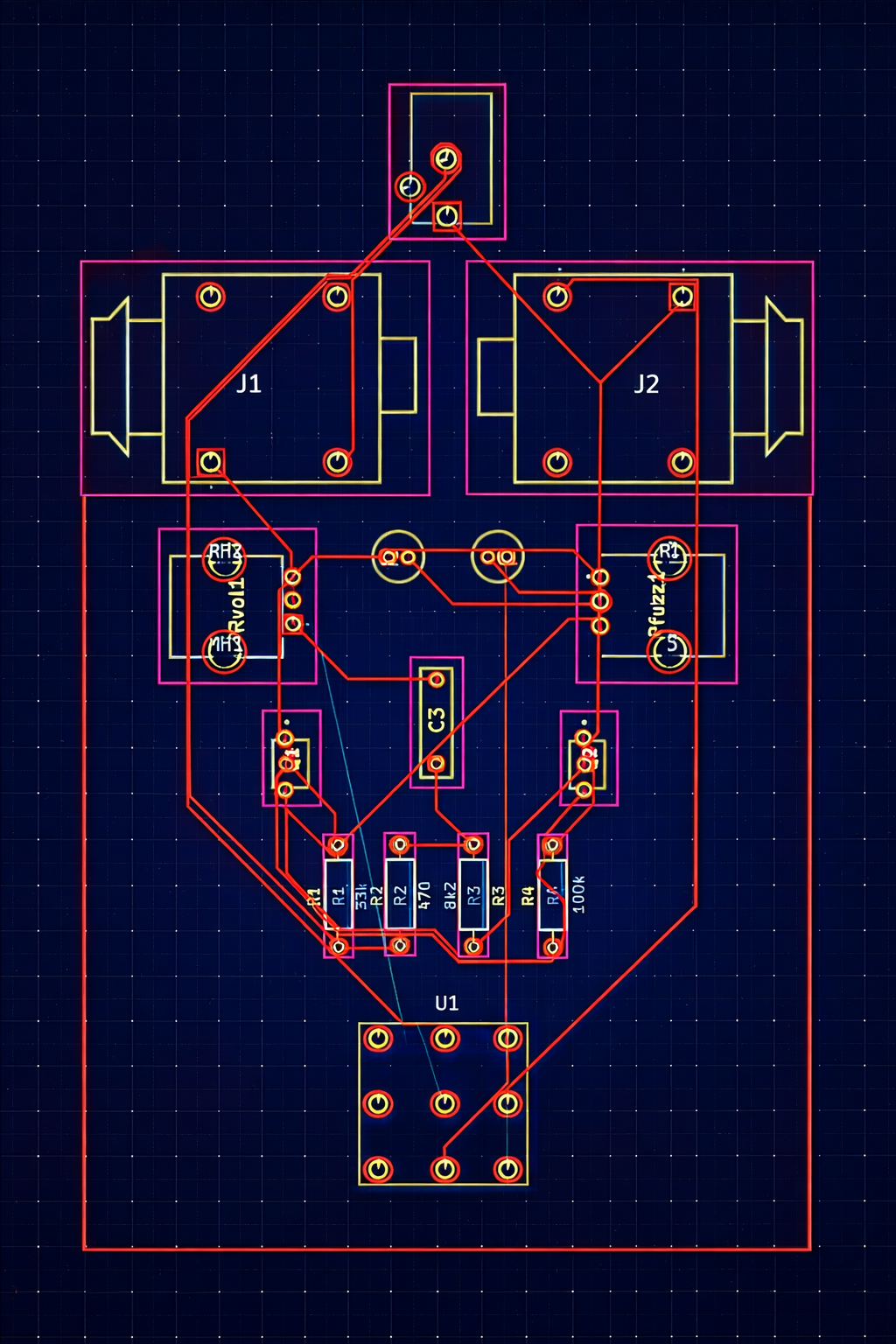
Analysis, redesign and custom PCB implementation of a classic analog fuzz circuit.

![[team]](https://cdn.prod.website-files.com/6939820137731e8b0f661575/694a9804bb4d494079d07b90_ChatGPT%20Image%20Dec%2023%2C%202025%2C%2002_19_56%20PMsreghh.png)
by Luca Biasio
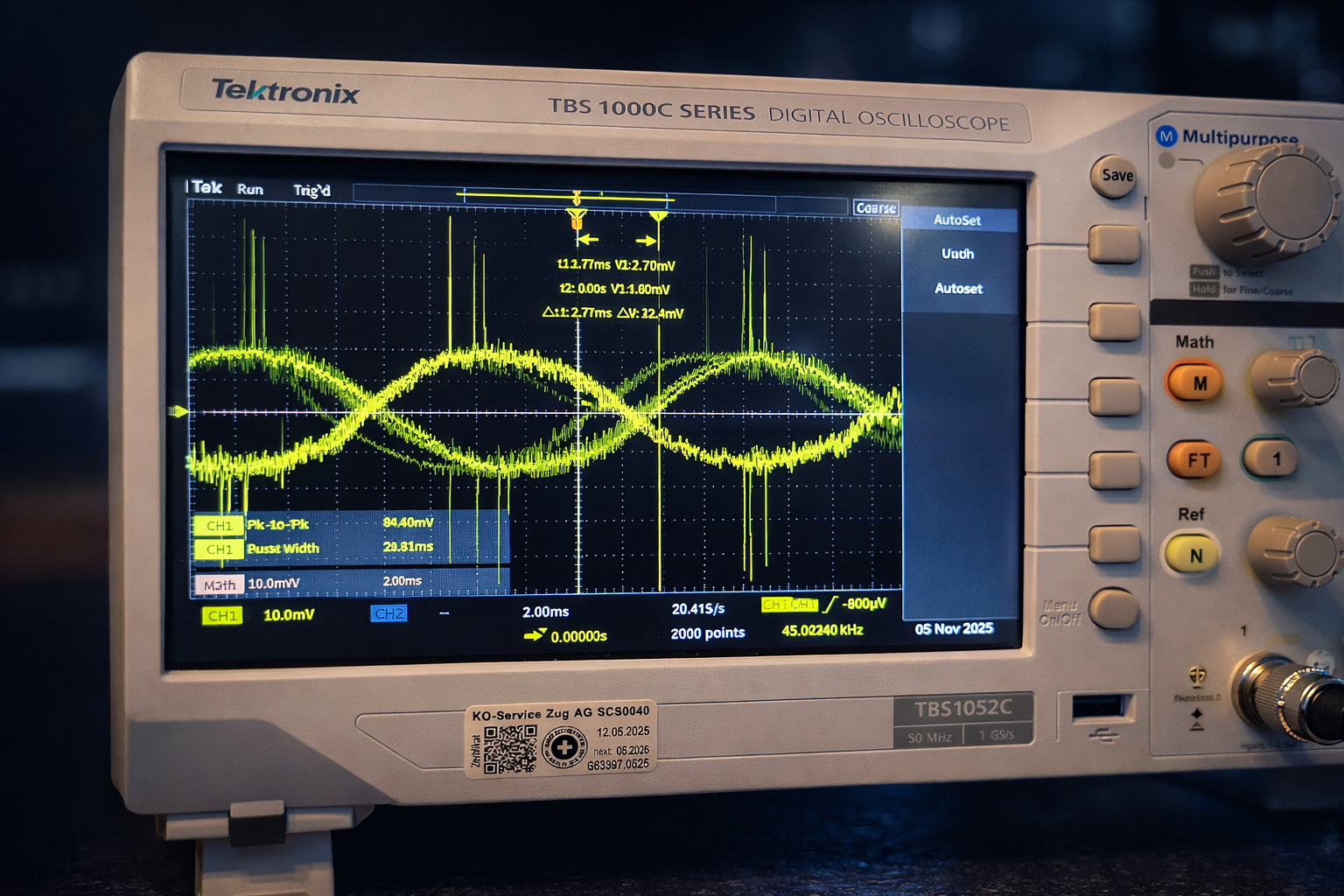
To verify the circuit behavior, multiple measurements were performed on the assembled prototype.Focus was placed on transistor biasing, signal amplification, waveform clipping, and noise performance.
All measurements were taken on the real hardware to compare theoretical expectations with practical results.
Measurements were carried out on the assembled PCB using a signal generator, oscilloscope, and electric guitar as input source.The input signal level and supply voltage were kept constant to ensure reproducible results.
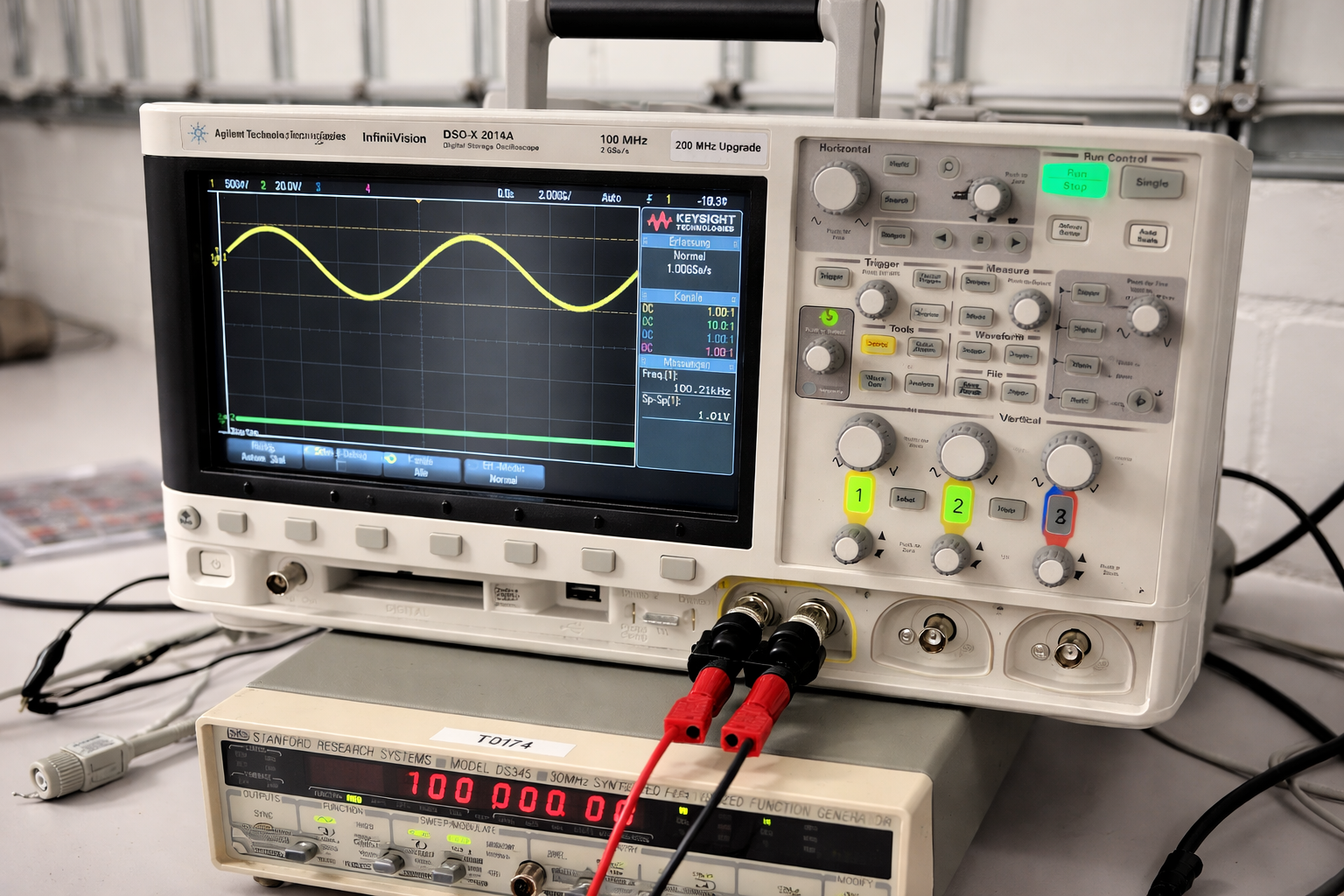
The oscilloscope measurements show the characteristic asymmetric clipping of the Fuzz Face circuit. Transistor biasing strongly influences the waveform shape, resulting indifferent distortion textures and dynamic response.
The measured waveforms confirm the expected asymmetric clipping behavior of the circuit. Bias point adjustments directly influence the harmonic content and output amplitude. The practical measurements align closely with theoretical calculations, validating the circuit design and component selection.
.png)
by Luca Biasio
This diagram shows the calculated high-pass corner frequencies of the input, feedback, and output coupling networks.The results confirm that the circuit preserves the relevant guitar frequency range while attenuating unwanted low-frequency components.
.png)
The total harmonic distortion (THD) increases with input amplitude as the transistor stages enter the nonlinear region.The curve illustrates the transition from nearly linear amplification to soft and eventually asymmetric clipping.
“Every project combines theoretical understanding with hands-on measurement to achieve stable and technically sound results.”
![[headshot] image of customer (for a medical clinic)](https://cdn.prod.website-files.com/6939820137731e8b0f661575/694a8426a800feaab92a07fc_3FMU1876_Biasio_klein.jpg)